
Tokenized-stock liquidity is flowing into Uniswap [$UNI] V4 just as the sector builds its DeFi footprint. V4 holds $59.1 million as of writing, giving it roughly 31% of the $192.6 million market and deeper liquidity than its rivals.
This increased liquidity helps make V4 more appealing as a source of greater trading volume, which translates into more investor activity.
Trailing behind is Kamino at $41.7 million, while Uniswap V3 comes in third, holding $20.9 million. This clearly shows liquidity is already shifting toward newer infrastructure.
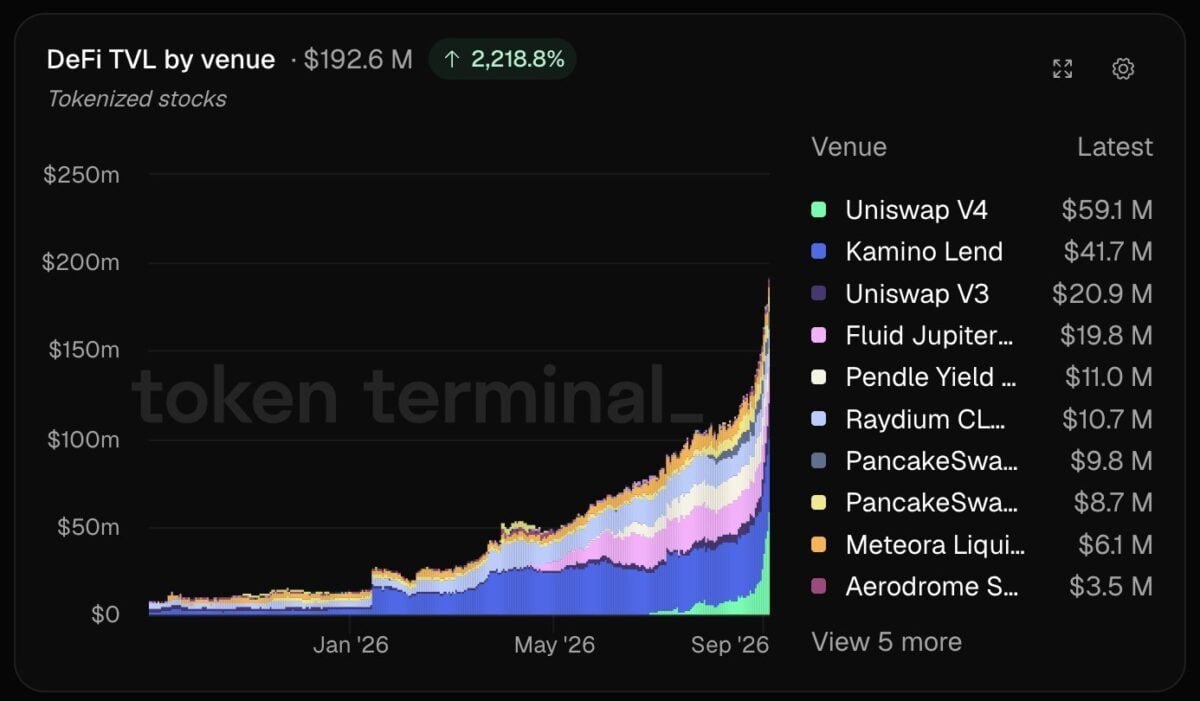
Together, the three control 63% of TVL. In turn, this leaves smaller venues competing for limited deposits. With sector TVL up 2,218.8%, further inflows into V4 could reinforce its liquidity advantage.
Sustained growth would strengthen Uniswap’s position as tokenized-stock trading expands.
Uniswap’s fee switch puts $UNI burns in focus
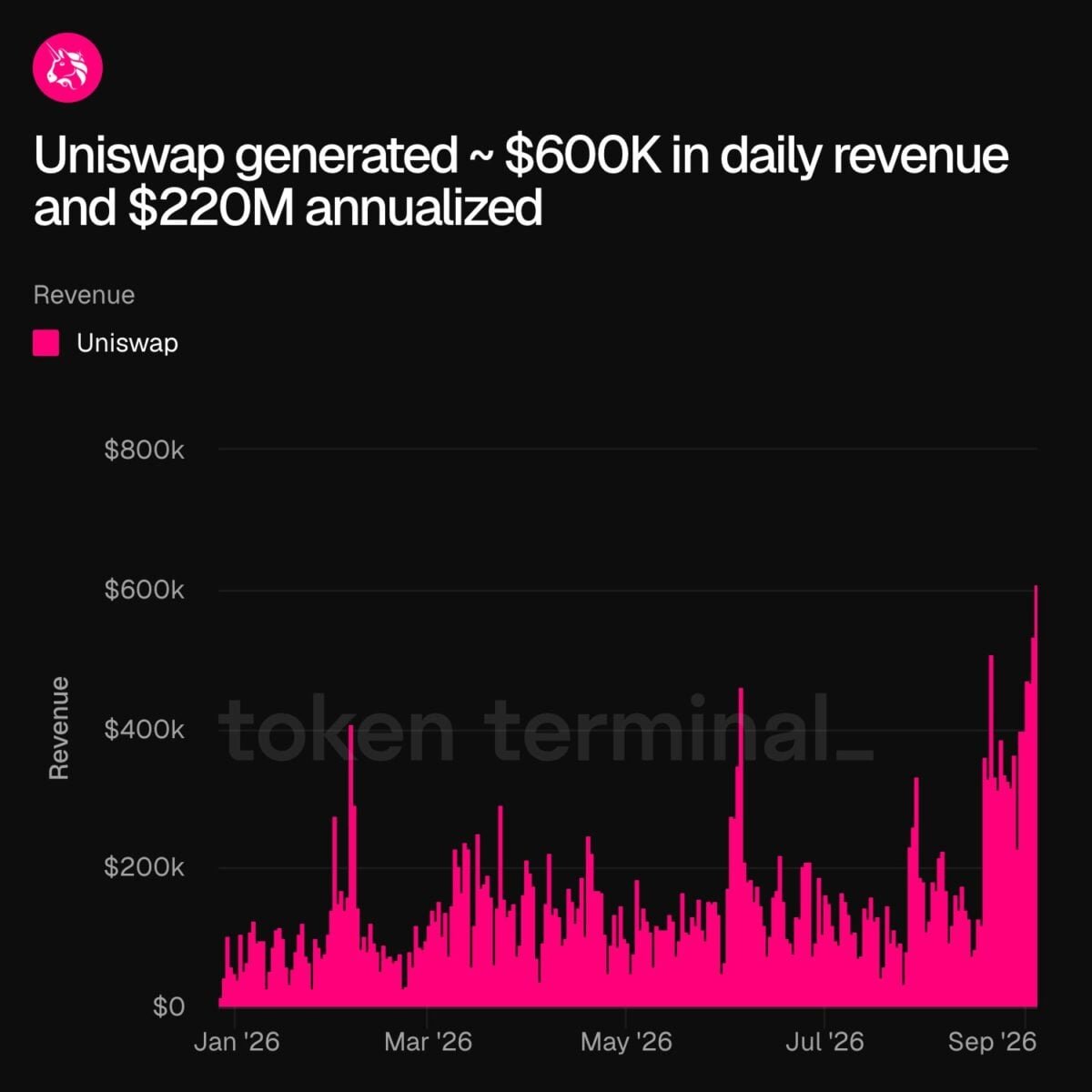
Meanwhile, growing usage is starting to feed directly into $UNI’s economics. As Uniswap V4 pulls more tokenized-stock activity, its daily revenue recently surged toward $600,000. This pushed the annualized run rate near $220 million.
Still, higher revenues will provide more capital for $UNI burns when the fee swap occurs, which reduces supply as activity on the protocol continues to expand.
Recent spikes over $400,000 also show this value capture strengthens with heavier trading periods.
Furthermore, v3 reportedly supports daily burns of roughly $598,000, while v4 already generates over $10 million in daily fees. That gap leaves considerable revenue between the current burn loop and a significant portion of revenue generated by v4.
Therefore, as the mechanism is extended to v4, it could accelerate removals of $UNI. All in all, growing V4 activity would then translate more directly into scarcity and stronger token value capture.
Arthur Hayes adds to $UNI demand
With $UNI’s economics improving, large holders are beginning to position around the same supply narrative. BitMEX cofounder Arthur Hayes received 244,406 $UNI worth $1.73 million through Flowdesk. This materially expanded his exposure.

Using an over-the-counter (OTC) route also limited immediate market disruption, allowing accumulation without chasing $UNI higher on exchanges.
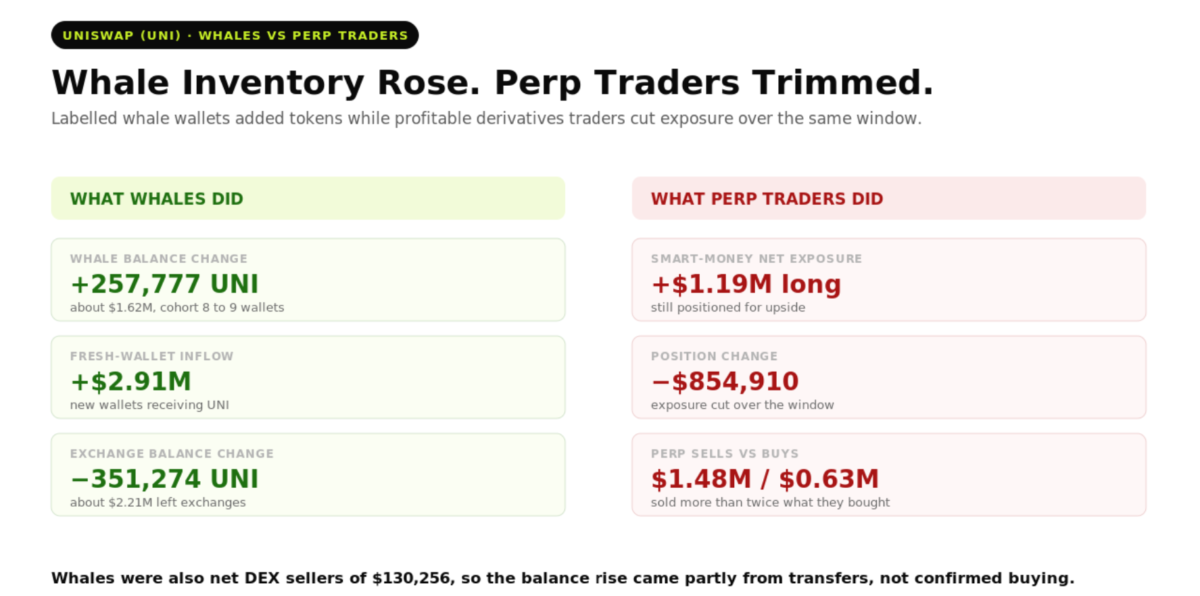
Meanwhile, fresh wallets added another $2.9 million, while exchange balances fell by more than 350,000 $UNI. Together, these movements point toward net absorption rather than distribution. Hayes also transferred $250,000 USDC to FalconX.
This move leaves additional purchasing capacity for future purchases. Ultimately, further accumulation would tighten liquid supply as protocol burns remove $UNI.
Final Summary
- Uniswap [$UNI] is gaining tokenized-stock liquidity as rising revenue strengthens $UNI burns.
- Whale accumulation and falling exchange balances could tighten $UNI supply further.