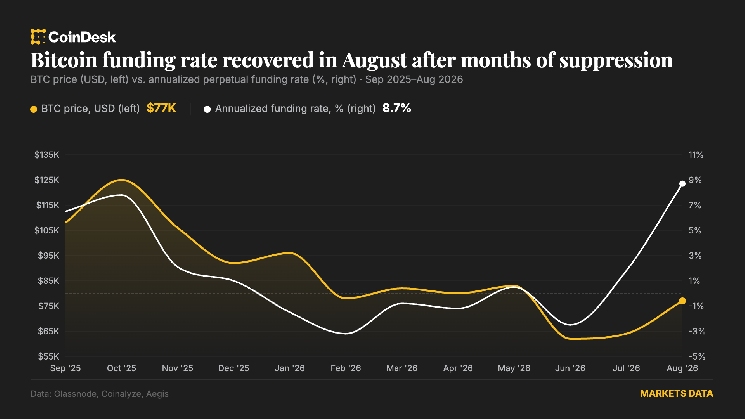
When bitcoin rocketed from around $62,000 to above $77,000 in a matter of days last week, the move wiped out $3 billion from leveraged short sellers who had built up bearish bets during the prior drawdown. But for trading firms, the price hike presented an opportunity - one that had nothing to do with predicting where prices would go next.
Major crypto trading firms, including Abraxas Capital, Fasanara Capital, and Wintermute, have quietly built what onchain data shows are hundreds of millions of dollars in short perpetual futures positions on Hyperliquid, the onchain derivatives exchange. Collectively, the three firms hold short positions of 138,569 $ETH (roughly $338 million) and 3,425 $BTC (around $265 million), according to onchain data tracked by Lookonchain.
At the same time, Abraxas Capital has been pulling large amounts of spot crypto off centralized exchanges. On-chain data from Arkham Intelligence shows the firm withdrew 73,872 $ETH — worth approximately $173 million — from Binance over the past four days alone.
Collecting yield, not making bets
The strategy is known as a cash-and-carry, or basis trade, and it has become one of the most common yield-generating plays in crypto markets during bull phases. The mechanics are straightforward: traders hold a spot crypto position while simultaneously shorting an equivalent amount via perpetual futures. Because the two positions offset each other, the trader has minimal exposure to price movements. What they capture instead is the funding rate — a periodic payment that longs must pay to shorts when the market is bullish.
$BTC funding rates remain positive and elevated across major exchanges, at around 0.01% per 8 hours, according to Coinglass data. Aggregated perpetual funding rates are currently around 0.0109% per hour for bitcoin and 0.0087% for ether, according to Coinalyze. The annualized yield from collecting funds runs into the high single digits — meaningful income at the scale at which these firms operate.
21shares Capital Markets noted this week that while the $BTC basis remains rich, funding itself is sitting at what it characterized as standard levels — suggesting the trade is attractive but not yet overheated. Crypto protocol Aegis put more precise numbers on the recovery: the 30-day average $BTC perpetual funding rate reached 6.7% annualized on Aug 24, while the 7-day average hit 8.7%.
The trade had largely dried up over the preceding months. Data from Glassnode shows that bitcoin's annualized perpetual funding rate spent much of the February through July period compressed or negative, as the market sold off from all-time highs above $120,000 and leveraged longs were steadily unwound. When longs aren't paying shorts, the carry trade stops generating income, and in a negative funding environment, it can actually cost money to hold.
This month’s surge changed that equation overnight. As leveraged short sellers were squeezed out by rising prices, funding flipped firmly positive, reopening the window for basis traders.