
A large Chainlink holder transferred another 620,420 $LINK to Coinbase on Sept. 7, extending a series of deposits to the U.S. exchange over the past three weeks.
The latest transfer was worth approximately $7.6 million when blockchain analytics account Onchain Lens reported the movement.
The same address has now sent 2.41 million $LINK, valued at about $26.04 million, to Coinbase during the period, according to the analyst’s post. Onchain Lens identified the originating wallet as 0xF5B007a6341AcC8CfEC581d8A1c5560bC19d9650.
The wallet had previously accumulated the tokens through withdrawals from Binance. Its later movement toward Coinbase represents a change from accumulation to exchange deposits, although the transfers do not confirm completed sales.
CHAINLINK WHALE SENDS ANOTHER $7.6M $LINK TO COINBASE
— Onchain Lens (@OnchainLens) September 7, 2026
The whale deposited another 620.42K $LINK (~$7.6M) to Coinbase.
Over the past three weeks, it has now sent 2.41M $LINK (~$26.04M) to Coinbase, which was previously accumulated from Binance.
Address:… https://t.co/tc5WD5lB5w pic.twitter.com/nEvyKb3Js3
Chainlink whale moved 2.41 million $LINK in three weeks
The latest 620,420 $LINK deposit represented approximately 25.7% of the address’s total three-week transfers. The preceding deposits amounted to roughly 1.79 million $LINK based on the cumulative figure supplied by Onchain Lens.
At the reported valuations, the newest transfer valued each $LINK at about $12.25. The complete three-week figure valued the transferred tokens at an average of approximately $10.80 each. These values reflect prices around the time of each movement rather than a confirmed execution price.
The address’s earlier Binance withdrawals suggest that the wallet accumulated $LINK before sending part or all of those holdings to Coinbase. However, blockchain records alone cannot identify the beneficial owner or explain the reason for each movement.
The address may belong to an individual, institution, trading firm or custody arrangement. Describing it as a whale refers to the size of the holdings and transfers, not a verified identity.
The wallet’s transaction history can be reviewed through the Ethereum block explorer Etherscan. Exchange destination labels also depend on address attribution and can change when analytics providers obtain new information.
Coinbase deposits raise selling risk but prove no sale
Transfers to centralized exchanges often receive attention because customers commonly deposit tokens before selling, converting or using them as collateral. A large deposit can therefore increase the amount of immediately tradable supply on an exchange.
Yet a Coinbase transfer does not establish that the holder sold the tokens. The wallet owner could move $LINK for custody, collateral, internal account management, over-the-counter settlement or a future trade that has not occurred.
Confirmation of selling would require additional evidence. This could include movements from Coinbase hot wallets, order-book activity, changes in exchange balances or a statement from the wallet owner. None of those details accompanied the Onchain Lens report.
The transaction also should not be treated as a transfer by Chainlink itself. The address has not been identified as belonging to Chainlink Labs, the Chainlink Foundation or a known project treasury.
Large exchange transfers can still affect trader expectations before any tokens are sold. Market participants may reduce exposure when they interpret a deposit as potential supply. That reaction can create volatility even when the wallet’s actual purpose remains unknown.
Crypto.news previously documented the reverse pattern, with large holders withdrawing hundreds of millions of dollars in $LINK while exchange balances declined. The latest Coinbase deposits show that individual whale behavior can differ from the broader holder trend.
$LINK price retains bullish momentum near $13
$LINK traded near $13.07 on Sept. 7, up approximately 7.1% during the latest session. Its intraday range extended from about $12.12 to $13.32.
The gain means the token was trading above the approximate valuation applied to the whale’s latest transfer. Its market price had also recovered strongly from the June and July lows near $7 to $8.
On the daily chart supplied with the market data, $LINK’s moving average convergence divergence remained positive. The MACD line stood near 0.7841, above the signal line at approximately 0.7069, while the histogram remained positive at about 0.0771.
Those readings indicate that upward momentum remained present. The latest red candle and narrowing distance between momentum readings, however, suggest that the rally could be entering a slower phase.
The relative strength index was approximately 72.47, above its moving average near 67.71. An RSI reading above 70 is commonly treated as overbought, although it does not independently establish that a decline will follow.
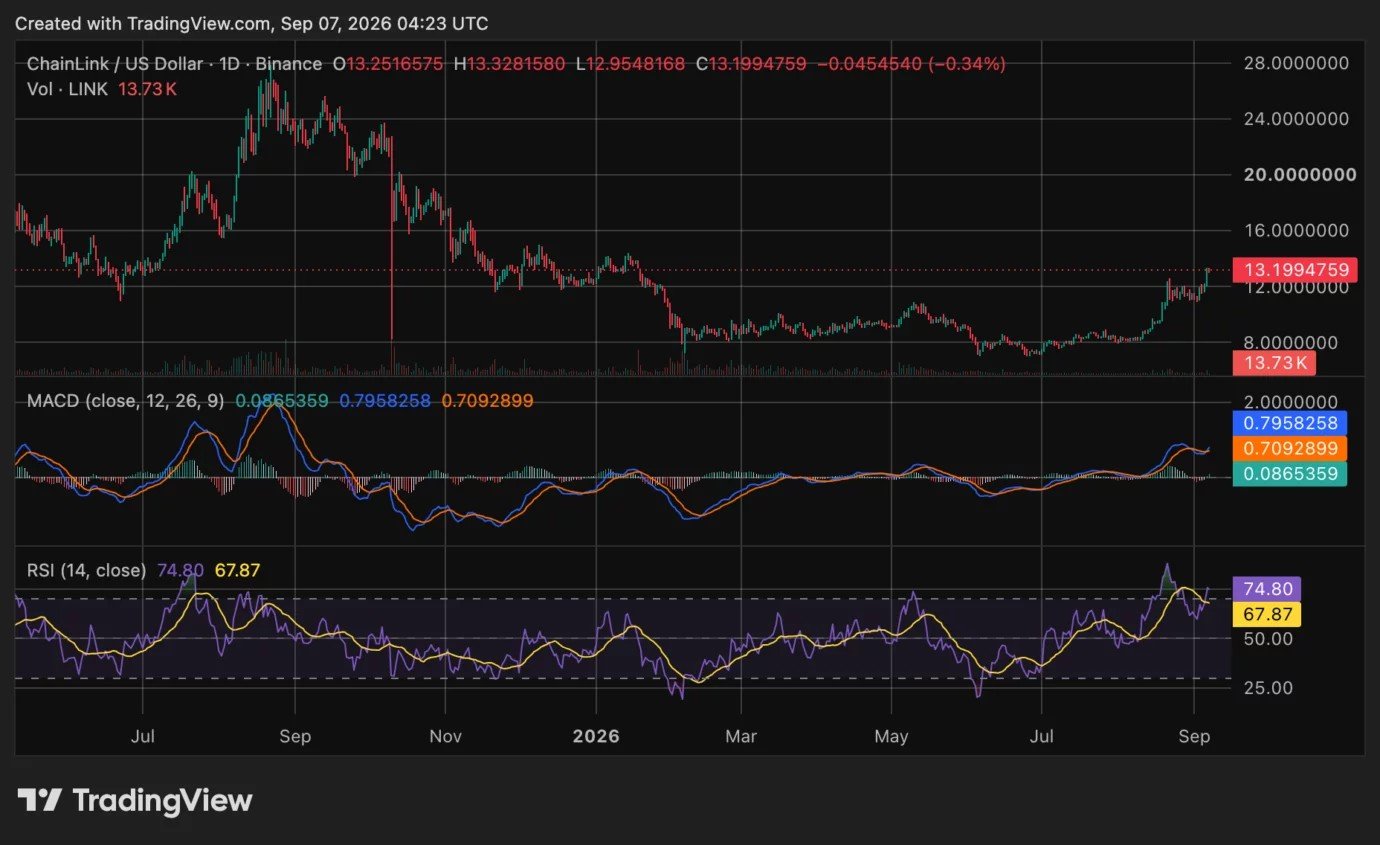
$LINK would need to maintain the $12 to $13 region to preserve its recent short-term recovery structure. A sustained move below that area would weaken the rebound, while a break above recent highs would extend it.
No evidence establishes that the whale deposit caused a specific $LINK price movement. The token traded within a broader crypto market and reacted to several factors beyond a single wallet transfer.
Chainlink adoption provides a separate demand narrative
The whale movement occurred as Chainlink continued expanding its oracle and cross-chain infrastructure. These developments provide a fundamental backdrop but do not determine what the unidentified holder plans to do.
Chainlink’s Cross-Chain Interoperability Protocol connects applications and assets across multiple blockchain networks. The system processed $4.9 billion in volume during the second quarter, up 353% from the corresponding period one year earlier, according to figures cited by Standard Chartered.
The bank also estimated that Chainlink secured more than $110 billion in value across oracle feeds and cross-chain services. Its long-term $LINK forecasts remain estimates rather than confirmed future prices.
Several large projects expanded their use of Chainlink during 2026. Aave adopted CCIP as the default infrastructure for cross-chain deposits, withdrawals, governance and GHO transfers, extending Chainlink’s role across the Aave ecosystem.
BitGo selected CCIP as the exclusive cross-chain provider for Wrapped Bitcoin. The decision moved its $7.3 billion WBTC ecosystem away from LayerZero and brought publicly announced CCIP migrations to roughly $14.6 billion.
Chainlink has also worked with traditional financial institutions. More than 50 banks joined a stablecoin foreign-exchange settlement test designed to combine blockchain settlement with existing Swift and ISO 20022 messaging systems. The project seeks to support atomic payment-versus-payment transactions, as detailed in Chainlink’s institutional settlement trial.
Bottomline Technologies recently partnered with Chainlink to connect blockchain-based payment tools with infrastructure serving hundreds of financial institutions. The agreement expanded Chainlink access across 600 banks.
These integrations can support demand for Chainlink services, but their effect on $LINK varies by product design, fee structure and token usage. They do not remove the short-term supply risk associated with large exchange deposits.
Further wallet activity will clarify the holder’s strategy
The next transactions from the whale address will help determine whether the Coinbase deposits are continuing. Additional transfers would raise the cumulative amount available within the exchange’s custody environment.
Withdrawals back to a private address would point in the opposite direction. They could indicate that the holder retained the tokens or completed an internal transfer rather than selling them.
Changes in Coinbase’s $LINK balances and transaction clusters may provide further context. Even then, analysts would need to separate this wallet’s activity from unrelated customer deposits and exchange operations.
For now, the blockchain confirms that 620,420 $LINK moved from the identified address toward Coinbase. The conclusion that the whale sold $7.6 million of $LINK would go beyond the available evidence.