
Solana price has decisively broken above the $100 mark, extending its strongest monthly advance in years as institutional access, ETF activity and changing tokenomics converge around $SOL. The breakout comes after months of resistance below the psychological level, putting the $110-$120 region firmly back on traders’ radar. With Schwab preparing to expand $SOL access and Solana moving toward a tighter issuance framework, the latest rally is developing into more than a rebound.
Schwab’s $SOL Expansion Broadens the Institutional Access
The latest move coincides with Charles Schwab’s decision to add Solana, Avalanche and Chainlink to Schwab Crypto in the coming months. The brokerage began rolling out direct Bitcoin and Ethereum trading in May, and the planned $SOL addition expands its digital-asset offering to three of the largest cryptocurrencies outside BTC and ETH. Schwab oversees more than $12 trillion in client assets and has about 39 million active brokerage accounts.
🔥BULLISH: Solana is EXPLODING, surging 13% today and about 50% in August for its strongest month since 2024.
— Coin Bureau (@coinbureau) August 27, 2026
The rally comes as Solana votes on cutting issuance and burning more $SOL, potentially triggering a supply squeeze.
Notably, Nasdaq-listed DeFi Development Corp. bought… https://t.co/fRjAD9l3CP pic.twitter.com/b4EggMjEMl
The significance is the distribution channel: Solana is moving closer to investors who already operate within a traditional brokerage environment rather than requiring them to use a crypto-native exchange. ETF activity is providing a separate indication of institutional demand. U.S. Solana-linked products have recorded sustained inflows, while Bitwise’s BSOL staking ETF posted a record $126 million in daily trading volume on August 27, taking seven-day turnover to about $500 million.
Solana’s Supply Curve Is Becoming Part of the Investment Case
The demand-side developments are being matched by a potentially important change to $SOL’s future supply. Solana validators have been voting on SGP-0002 and SGP-0003, proposals that would accelerate disinflation and increase the amount of transaction-related fees permanently removed from circulation.
SGP-0002 would increase the annual disinflation rate from 15% to 30%, bringing Solana toward its 1.5% terminal inflation rate considerably faster and reducing projected issuance by about 18.9 million $SOL over six years. SGP-0003 would introduce a resource-based fee that is burned, with estimates suggesting daily $SOL burns could rise from roughly 600-800 to around 7,500-9,000 $SOL under current activity levels.
$SOL Price Analysis: Can Buyers Defend $100?
Solana’s chart structure has improved substantially after $SOL cleared the $100 psychological barrier. The token had previously broken above the $78-$79 resistance zone and subsequently established a higher base around $92-$97 before making the latest move through $100. That sequence is important because it shows buyers defending higher levels rather than relying on a single vertical move.
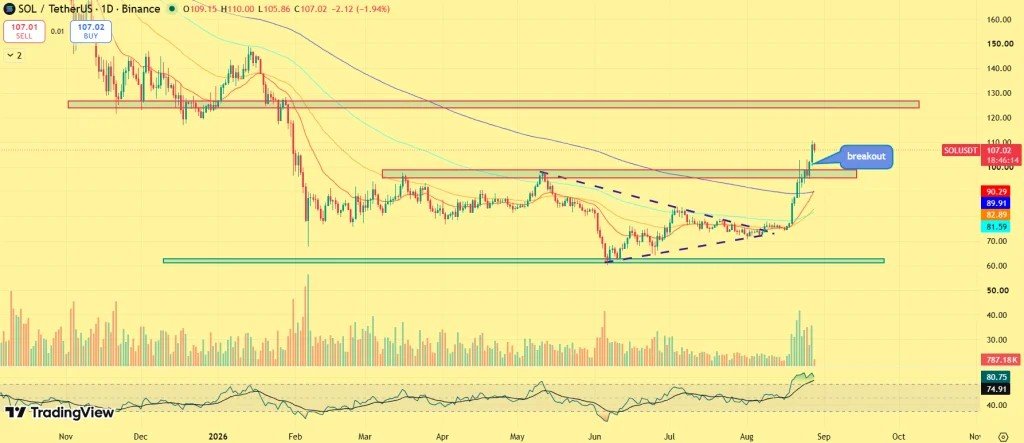
The immediate resistance is now around $105-$110. A sustained daily close above this area would strengthen the breakout and expose the $115-$120 region, with the broader $125-$130 supply zone becoming relevant if momentum continues. At the same time, $SOL’s rapid rally has pushed momentum indicators into elevated territory. The daily RSI is around the overbought zone, while the recent run of positive sessions leaves the market vulnerable to profit-taking. A pullback toward $100-$105 would not necessarily damage the bullish setup if buyers defend the former resistance as support. A sustained move back below $100, however, would weaken the breakout and bring the mid-$90s back into focus.
Final Outlook
$SOL’s move above $100 has changed the immediate technical structure, but the more important development is the convergence of institutional access, ETF demand and a potential reduction in future supply growth. Schwab’s planned listing expands the potential buyer base, while the governance proposals could make the token’s issuance profile more conservative if implemented.
The $100-$105 is the key support zone and $110-$120 is the next upside test. Holding the breakout would keep the broader recovery intact, while a failure to defend $100 would suggest that the market needs to consolidate after the recent acceleration. Solana has cleared the level that held back the recovery for months; the next phase will depend on whether $100 becomes a durable floor rather than another temporary breakout.