
$NEAR Protocol is suddenly back on traders’ radar. The token has surged more than 52% in a week, breaking above a descending trendline that had contained its price for months, while a new confidential perpetual futures product powered by Hyperliquid adds fresh momentum to the ecosystem’s expanding utility narrative. With $NEAR approaching the $4 resistance zone, the market is now facing a decisive test: can this breakout develop into a sustained recovery, or will overheated momentum trigger another rejection?
$NEAR’s Latest Catalyst Comes From Confidential Perpetual Futures
The $NEAR ecosystem has introduced confidential perpetual futures trading powered by Hyperliquid, according to the update shown in the provided market discussion. The product reportedly allows users to open perpetual positions without publicly linking their trades to their accounts, introducing a privacy-focused feature into the derivatives market.
The launch arrives as $NEAR continues to reposition its ecosystem around infrastructure rather than a conventional Layer-1 narrative. Chain abstraction, cross-chain liquidity, AI agents and tokenized assets are becoming increasingly central to the protocol’s broader strategy.
PERPS NOW CONFIDENTIAL BY DEFAULT
— $NEAR Protocol (@NEARProtocol) September 17, 2026
Open a position from the account you already use, and nobody can tell it's yours.
Only on https://t.co/THkSBWMu2L pic.twitter.com/sU9oEhb3cj
Confidential derivatives could expand the range of financial applications built around $NEAR-linked infrastructure. However, the market impact will ultimately depend on trading activity, liquidity, user adoption and whether the product generates sustained demand.
$NEAR Is Building a Bigger Narrative Beyond Another Layer-1
The latest rally comes alongside renewed discussion around $NEAR Intents, which aims to simplify cross-chain transactions by allowing users to specify an intended outcome while solvers handle the underlying execution.
Instead of requiring users to navigate individual blockchains, bridges and liquidity pools, the system is designed to coordinate transactions across networks. This approach could become increasingly relevant as crypto applications move toward cross-chain execution, automated payments and AI-powered financial activity.
$NEAR’s AI infrastructure ambitions add another dimension. AI agents that can interact with stablecoins, tokenized assets and liquidity across multiple chains require more than a blockchain settlement layer. They need transaction execution, secure account access, payments and cross-chain coordination. $NEAR is positioning its infrastructure around these requirements. The challenge is converting that technological direction into measurable usage, protocol revenue and sustained token demand.
$NEAR Price Analysis: 52% Weekly Surge Brings $4 Resistance Into Focus
The weekly $NEAR/USDT chart shows a sharp move higher from the lower consolidation region, followed by a breakout above the descending trendline that had defined the broader corrective structure. $NEAR recorded a weekly gain of approximately 52.61%, with the token trading near $3.50 at press time. The breakout was accompanied by stronger trading activity, highlighting increased participation as price moved beyond the trendline.
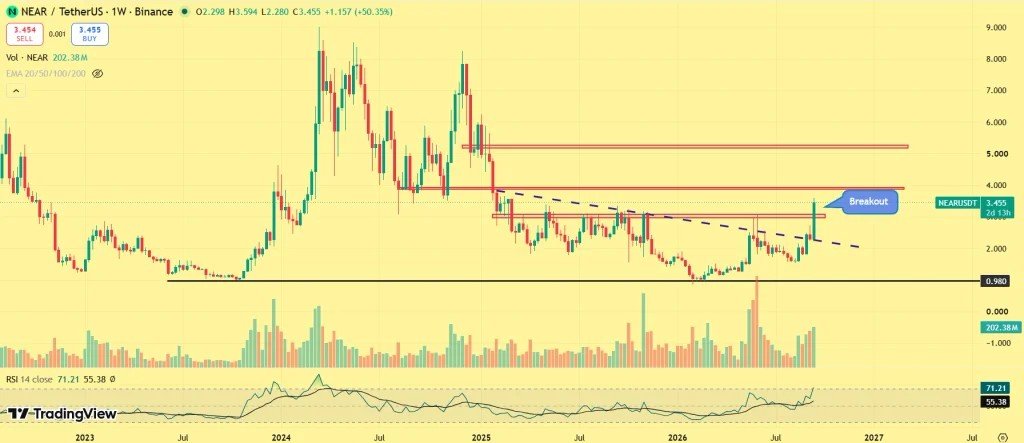
The immediate hurdle is positioned around $4.00. A decisive weekly close above this level, supported by sustained volume, could strengthen the breakout and expose the next resistance zones near $5.30 and $6.00. However, the move has already pushed the weekly RSI above 70, signalling elevated momentum and a growing possibility of short-term profit-taking. A pullback following such a rapid surge would not automatically invalidate the breakout, provided buyers defend the key retest region. The first support area to monitor sits around $3.00–$3.20.
Holding this zone could help establish the previous resistance area as support. A breakdown below it, however, would weaken the immediate bullish structure and potentially expose the $2.00–$2.40 region. The next move therefore depends less on the size of the initial surge and more on whether $NEAR can maintain its breakout above the former trendline.